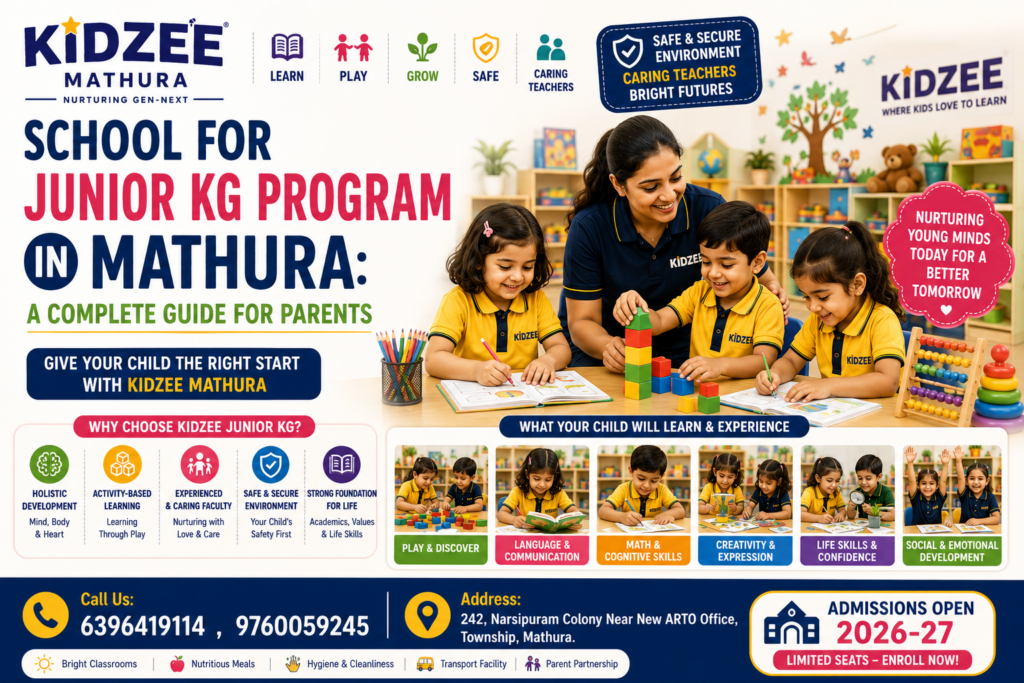
Choosing the right Junior KG school is an important milestone in your child’s educational journey. At this stage, children begin developing the academic, social, emotional, and communication skills that prepare them for primary school. A well-designed Junior KG program helps children become independent learners while nurturing their natural curiosity.
If you’re looking for a school for Junior KG program in Mathura, this guide will help you understand the importance of Junior KG education, what children learn, and how to choose the right school for your little one.
What Is a Junior KG Program?
Junior KG (Junior Kindergarten) is designed for children between 4 and 5 years of age. It acts as a bridge between nursery education and formal schooling by introducing structured learning in a fun, engaging, and age-appropriate manner. At this stage, children begin developing literacy, numeracy, communication, creativity, and problem-solving skills while continuing to learn through play and exploration.
Why Is Junior KG Important?
The Junior KG years are crucial because children are ready to absorb new concepts quickly. A quality program helps them:
- Build confidence and independence
- Improve language and communication skills
- Develop early reading and writing abilities
- Learn basic mathematics concepts
- Strengthen logical thinking
- Improve concentration and memory
- Develop social and emotional skills
- Prepare for primary school
These foundational skills support lifelong learning and academic success.
What Do Children Learn in Junior KG?
A comprehensive Junior KG curriculum focuses on the overall development of the child.
1. Language Development
Children learn to:
- Recognize letters and sounds
- Improve vocabulary
- Speak confidently
- Listen carefully
- Understand simple stories
- Begin reading readiness
Phonics-based activities help children develop strong language skills from an early age.
2. Early Reading and Writing
Children gradually learn:
- Letter formation
- Tracing
- Pencil grip
- Name writing
- Simple word recognition
- Picture reading
Learning is introduced through fun activities instead of rote memorization.
3. Mathematics Skills
Basic numeracy includes:
- Number recognition
- Counting
- Shapes
- Patterns
- Sorting
- Measurement
- Simple addition concepts
- Logical reasoning
Hands-on learning activities make mathematical concepts easy to understand.
4. Creative Learning
Creativity is encouraged through:
- Drawing
- Painting
- Art and craft
- Music
- Dance
- Storytelling
- Role play
Creative activities help children express themselves and build imagination.
5. Social and Emotional Development
Junior KG helps children learn how to:
- Share with others
- Work in teams
- Respect classmates
- Express emotions positively
- Follow routines
- Develop self-confidence
These life skills are just as important as academic learning.
Characteristics of a Good Junior KG School
When searching for a school for Junior KG program in Mathura, parents should consider several important factors.
Safe and Child-Friendly Campus
Look for schools that provide:
- CCTV surveillance
- Secure entry and exit
- Clean classrooms
- Safe play areas
- Hygienic facilities
A secure environment allows children to learn confidently.
Qualified Teachers
Experienced early childhood educators understand how young children learn. They create engaging classroom experiences while giving every child individual attention.
Activity-Based Learning
Modern preschool education emphasizes learning through:
- Games
- Storytelling
- Hands-on activities
- Group projects
- Outdoor play
- Music and movement
This approach makes learning enjoyable and meaningful.
Holistic Curriculum
The best Junior KG programs focus on more than academics. They support children’s intellectual, physical, emotional, creative, and social development, helping them become confident and well-rounded learners.
How to Choose the Best School for Junior KG Program in Mathura
Before finalizing admission, parents should:
- Visit the school campus.
- Meet the teachers.
- Understand the curriculum.
- Check safety measures.
- Observe classroom activities.
- Review hygiene standards.
- Ask about teacher-to-student ratio.
- Understand assessment methods.
- Learn about parent-school communication.
Taking time to evaluate these factors can help ensure the best learning environment for your child.
Why Early Learning Matters
Children between four and five years experience rapid brain development. A quality Junior KG program supports this growth by encouraging curiosity, creativity, communication, and critical thinking.
Children who receive strong early education often adapt more easily to primary school and become confident learners in later years.
Junior KG at Kidzee Mathura
For parents searching for a trusted school for Junior KG program in Mathura, Kidzee Mathura offers a structured curriculum designed for children aged 4–6 years. The program aligns with the National Education Policy (NEP) foundation stage and emphasizes activity-based learning, early literacy, numeracy, creativity, and holistic child development. The school also maintains qualified educators and a low teacher–student ratio to provide personalized attention.
Tips for Parents
Parents can support their child’s learning by:
- Reading books together every day.
- Encouraging conversations.
- Limiting screen time.
- Playing educational games.
- Praising effort instead of perfection.
- Creating a daily routine.
- Encouraging curiosity through questions and exploration.
When school and home work together, children gain confidence and enjoy learning.
Frequently Asked Questions
What is the ideal age for Junior KG admission?
Most schools admit children between 4 and 5 years of age, although admission criteria may vary slightly.
What skills are taught in Junior KG?
Junior KG focuses on early literacy, numeracy, communication, creativity, logical thinking, motor skills, and social-emotional development.
Why is Junior KG important before primary school?
Junior KG helps children develop classroom readiness, confidence, language skills, and learning habits that make the transition to primary school smoother.
How do I choose the best Junior KG school in Mathura?
Visit the campus, evaluate the curriculum, meet teachers, observe classrooms, review safety standards, and ensure the school follows a child-centered approach.
Choosing the right school for Junior KG program in Mathura is one of the most valuable investments you can make in your child’s future. A nurturing environment, experienced educators, engaging curriculum, and activity-based learning help children develop the confidence and skills they need for lifelong success.
As you explore different schools, focus on finding a place where your child feels safe, happy, and inspired to learn. A strong Junior KG program builds the foundation for academic achievement, social development, creativity, and a lifelong love of learning.